


Tarova: Astral Tarot & Zodiac
AI Translator
Tarova: Astral Tarot & Zodiac caught my attention because it sits in a familiar space—daily tarot, horoscope reading, relationship compatibility, and an AI-style oracle experience—but presents those ideas as something I could return to rather than a one-time novelty. I approached it as a personalization app, not as a replacement for practical advice, and that distinction shaped my experience. It is most enjoyable when I use it as a short reflective pause: a way to put a feeling into words, consider a question from another angle, or start the day with a small ritual.
The app is developed by AI Translator and is free to install, although optional in-app purchases range from $1.49 to $49.99 per item. It is rated for Everyone, works on Android 8.0 and later, and the current version is 1.1.12. Those details make it accessible to a broad audience, but accessibility is not the same as universal appeal. If you want a serious astrology reference, a detailed tarot-learning tool, or advice grounded in evidence, this is not where I would begin. If you enjoy symbolic prompts and light personalization, however, it has a reasonable chance of becoming part of your routine.
Why the first week feels more engaging than a single horoscope
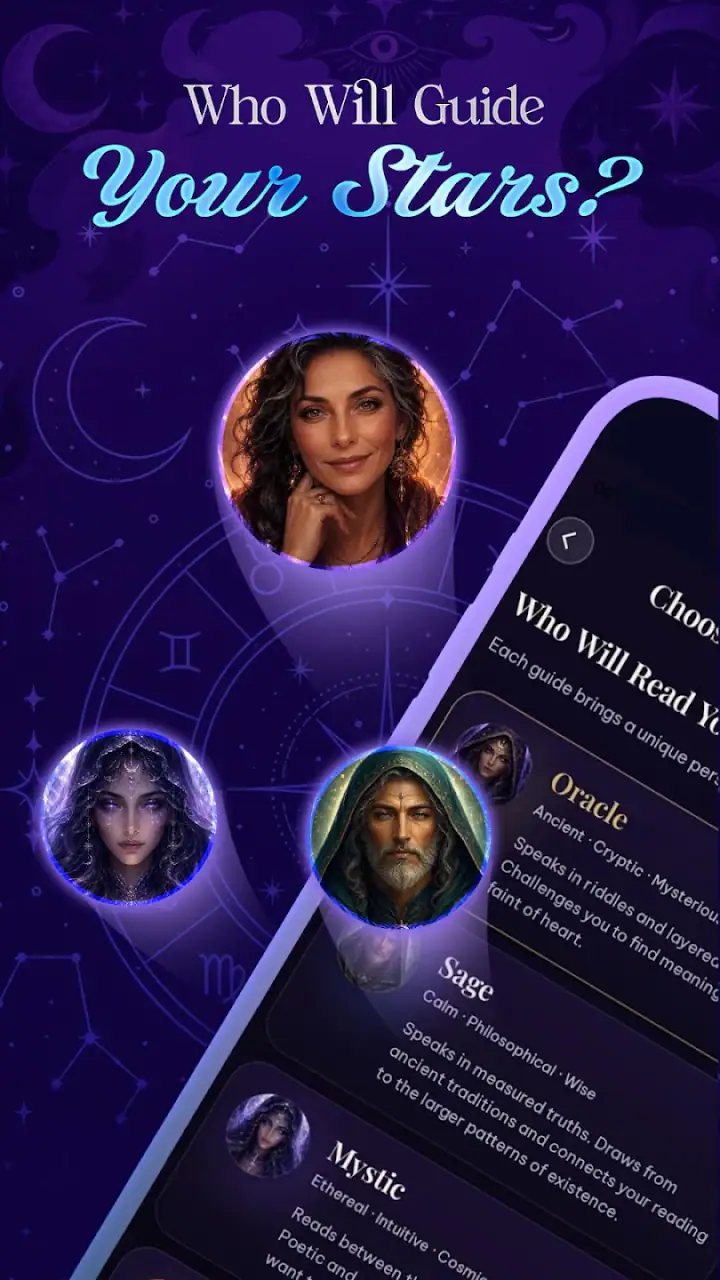
My first impression was shaped by the variety of questions the app invites. A daily horoscope gives you a quick general direction, while tarot adds a more focused symbolic layer. Love compatibility shifts the attention toward another person or a relationship dynamic, and the oracle-style guidance encourages a question-and-response interaction. That combination gives the app more staying power during the opening days than an app that offers only one daily zodiac paragraph.
The important point is that these elements serve different moods. On a busy morning, I can treat the horoscope as a quick check-in. When I have a specific concern, a tarot reading feels more appropriate because the symbols invite interpretation instead of giving me one fixed sentence to accept. Compatibility readings are more social and playful, while the AI oracle angle feels more conversational. The result is a personalization app that can adapt to the kind of attention I have available.
I would not describe the experience as a substitute for a professional tarot reader or astrologer. The value is in the prompt, not in an objective prediction. I found the readings most useful when I asked myself what resonated, what did not, and why. That small mental step turns passive scrolling into reflection. Without it, the app can become another stream of agreeable statements that are easy to read and just as easy to forget.
Related News

Why WhatsApp Messenger Still Makes Everyday Communication Feel Easy

Jurassic World: The Game Is the Better Dino Tycoon for Strategic Players

Threads in Real Life: Who Should Join, Lurk, or Leave

How SHEIN Turned Shopping Into an Endless Content Feed

How to Make Fortnite Feel Smarter on Mobile

Should You Switch to Microsoft Outlook on Mobile?
During the first week, novelty does a lot of work. Opening a new reading feels rewarding because there are several directions to explore. I can compare how a general daily message feels with a more personal question, or move from a relationship topic to a broader mood check. This makes the app approachable for someone who has never used tarot before. I do not need to know card meanings or understand astrological terminology before trying it.
That beginner-friendly quality is one of its strongest advantages. Traditional tarot resources often assume that the reader wants to study spreads, card symbolism, reversals, and history. Dedicated astrology apps can also become dense with charts and terminology. Tarova: Astral Tarot & Zodiac takes a lighter route. It is better suited to someone who wants an accessible interpretation than to someone who wants a structured course.
How I would use it in an ordinary day
A realistic use case is a short evening reset. After a difficult conversation at work, I might open the app and choose a reading connected to relationships or personal direction. I would read the result once, then write down one sentence about the part that felt relevant and one practical action for the next day. For example, if the reading encourages patience, the useful takeaway is not to wait for fate; it is to decide where I can communicate more calmly or avoid reacting immediately.
Gallery
That workflow is more valuable than repeatedly requesting readings until I receive a reassuring answer. Repetition can make almost any divination app feel persuasive because the user starts selecting the message they prefer. My advice is to treat the first reading as a prompt, keep the question specific, and avoid using the app to make high-stakes decisions about health, money, safety, or legal matters.
Another useful habit is to separate entertainment from emotional dependence. I can enjoy a compatibility reading with a partner or friend, but I should not use it as proof that someone is trustworthy, untrustworthy, suitable, or destined to stay in my life. The app can encourage a conversation; it cannot replace one. That boundary matters especially because relationship readings can feel personal even when the underlying interpretation is broad.
What makes the app approachable for newcomers
The free entry point helps reduce the commitment required to try it. I can explore the basic idea before deciding whether it deserves a place in my routine. The Everyone rating also signals that the tone is intended to be broadly accessible rather than built around mature or specialized material. Families should still use their own judgement about how children interpret predictive content, but the general presentation is not aimed at an adult-only audience.
The app’s public response is encouraging without being overwhelming: it has a 4.6 average from around 944 ratings, with 17 written reviews and over 100K installs. I see that as evidence of genuine interest, not proof that every reading will feel accurate or that the experience will suit everyone. A high average can reflect a satisfying first impression, while long-term value depends on whether the app remains useful after the initial curiosity fades.
That is the first-week test I would apply. After several days, ask whether the readings are helping you think, relax, or maintain a pleasant ritual. If the only reason to open the app is the hope of receiving a different answer, the novelty is already becoming a weakness. The app works best when it supports a habit you control, not when it controls the habit.
Whether it earns attention from month to month
Long-term value is harder to judge than first-week appeal because the core activities are naturally repetitive. A daily horoscope is designed to be revisited, but repeated exposure can also make its format feel predictable. Tarot and oracle readings offer more room for variation, yet the user still returns to a familiar cycle: ask, read, interpret, move on. The app needs to become part of a meaningful routine rather than simply another notification-shaped temptation.
For me, the strongest monthly use is occasional rather than constant. I would open it when beginning a new project, thinking through a personal question, or checking in with my mood at the end of a week. I would be less likely to use it every morning without interruption. That may sound like a limitation, but it can actually protect the experience from burnout. A reflective tool does not need to be consumed daily to be useful.
Users who enjoy rituals may get more lasting value. They could keep a private note of the question they asked, the reading they received, and what happened afterward. The purpose is not to prove that a prediction came true. Instead, the record can reveal patterns in the user’s own concerns: perhaps the same relationship worry appears repeatedly, or perhaps the user keeps asking for certainty when the practical need is a conversation. This turns the app into a mirror for attention rather than a fortune-telling authority.
One of the less obvious trade-offs is that personalization can make a reading feel more relevant without making it more reliable. When a message seems to describe my situation, I may naturally focus on the matching details and overlook the general language around them. I recommend reading the result once, identifying the specific part that applies, and then closing the app before searching for a second interpretation. That simple limit preserves the reflective benefit and reduces compulsive checking.
Compatibility tools can also have a longer life when used as conversation starters. Instead of asking whether two signs are “meant” to be together, I would use the result to discuss communication styles, expectations, or recurring disagreements. The reading becomes a neutral prompt that makes an awkward subject easier to raise. This is a better use of the feature than treating zodiac compatibility as a final verdict on a relationship.
The AI oracle concept has a similar strength and weakness. Its conversational framing can make it easier to express a vague concern, especially when I do not know how to formulate a journal prompt. At the same time, an AI-generated answer can sound confident even when the question is ambiguous. I would therefore judge its quality by the usefulness of the reflection it sparks, not by whether it appears to know my future.
Where it compares well with familiar alternatives
Compared with a printed tarot deck, the app is quicker and more convenient. I do not need to shuffle cards, learn a spread, or keep a guidebook nearby. That makes it ideal for a short break or for someone who is curious but not ready to buy physical materials. The trade-off is atmosphere and control: a physical deck can feel more personal, while an app provides an interpretation that may be less open-ended.
Compared with a general horoscope website, Tarova offers a more focused experience because it combines several forms of guidance in one place. A website may be better when I want to compare detailed zodiac information or browse a wide range of articles. This app is better when I want a compact ritual with less reading and fewer distractions.
Compared with a dedicated astrology application, it appears more approachable for casual users because it does not require me to begin with a complex birth chart or a deep study of planetary placements. Someone who wants exact chart calculations, transit tracking, or an educational explanation of astrological systems would probably be happier with a specialist tool. Tarova’s advantage is breadth and ease, not technical depth.
Compared with journaling, the app supplies an immediate starting point. I do not have to face a blank page. However, journaling gives me more ownership over the final insight and avoids the risk of accepting a generated interpretation too literally. My preferred combination is to use a reading as the opening prompt, then write my own response in plain language.
The maintenance burden behind a seemingly simple ritual
The practical burden is not installation or learning. It is managing how often I use the app and how much authority I give its messages. A daily routine can be pleasant at first, but if I feel obligated to check every horoscope or repeat a question several times, the ritual becomes maintenance rather than relaxation. I would set a personal rule before using it regularly: one reading for one question, followed by a real-world action or a decision to leave the subject alone.
Optional purchases deserve the same deliberate approach. The app is free, but individual in-app items can cost from $1.49 to $49.99. Before paying, I would ask whether the purchase adds a genuinely different way to use the app or simply extends a momentary feeling of reassurance. I would also avoid buying while emotionally unsettled, particularly after a troubling relationship reading. A pause until the next day is a simple way to separate interest from impulse.
Another maintenance issue is interpretation fatigue. If every reading is treated as an important message, the user can end up spending more mental energy decoding symbols than addressing the original problem. I find the app healthier when I give myself permission to dismiss a reading. Not every result needs to fit, and a message that feels vague does not require a second or third attempt.
Because the current version is 1.1.12, I would keep the app updated through the normal store process, especially if I plan to use it as a regular habit. Updates can matter for stability and compatibility with newer devices. On the other hand, I would not install it on an older phone without checking that the operating system meets its Android 8.0 minimum. That requirement is modest, but it is still worth checking before troubleshooting an installation problem.
What may cause the experience to become tiring
The biggest source of fatigue is repetition. Horoscope language can begin to blur together, especially when I read it every day without recording what actually mattered. Tarot readings may feel fresher because the symbols change, but the emotional themes—patience, communication, uncertainty, confidence, change—naturally recur. That is not necessarily a flaw in the app, but it limits how much new information I can expect from each visit.
A second source is the tension between comfort and clarity. A reassuring message can be pleasant, yet it may not help me decide what to do. A challenging message can feel meaningful, but it may also encourage unnecessary worry if I interpret it as a warning. I would avoid opening the app when I am already highly anxious and looking for certainty. In those moments, a trusted person, a written plan, or qualified professional support is a better choice.
The third issue is that broad personalization can feel accurate to many people at once. This is particularly relevant to compatibility readings. A result may offer useful language for discussing a relationship, but it should not be treated as a measurement of character or future behavior. The more consequential the decision, the less appropriate it is to let the reading lead.
There is also a possible fatigue point around paid content. Even when the free experience is enough to understand the concept, repeated prompts toward optional purchases can change how relaxed the app feels. Since the available items span a wide price range, I would review each purchase carefully and decide in advance whether I am willing to spend anything. Users who prefer completely free tools may find that a notebook, a physical deck, or a free horoscope source better matches their expectations.
My long-term verdict on keeping Tarova installed
I would keep Tarova: Astral Tarot & Zodiac installed if I wanted a lightweight reflection ritual with several related themes in one app. Its best qualities are its approachable mix of tarot, horoscope, compatibility, and oracle-style guidance, along with a free starting point that makes experimentation easy. I can imagine returning to it during a weekly reset, before journaling, or when I want a playful way to begin a conversation.
I would not keep it as a daily authority or use it to make serious decisions. The app becomes less valuable when I chase certainty, repeat readings until one feels comfortable, or confuse an interpretation with evidence. Its lasting place depends on boundaries: one question at a time, occasional use, and a willingness to translate a symbolic message into a practical thought rather than a prediction.
For casual users, the app earns a trial because it offers more variety than a single horoscope feed and less commitment than learning a full tarot system. For experienced tarot readers or astrology enthusiasts, it may feel too light if they want detailed study, technical charts, or complete control over interpretation. For anyone uncomfortable with predictive or AI-guided content, a journal or meditation app would be a better fit.
My final judgement is that Tarova: Astral Tarot & Zodiac is most successful as a prompt for self-reflection, not as a source of certainty. The novelty can carry it through the first week, but a lasting habit requires moderation and personal involvement. If you use the readings to pause, ask better questions, and return to real-life choices with a clearer head, it can earn a small, recurring place on your phone. If you expect it to solve uncertainty for you, the appeal is likely to fade quickly.
FAQs for Tarova: Astral Tarot & Zodiac
What is Tarova: Astral Tarot & Zodiac, and what can I use it for?
Tarova: Astral Tarot & Zodiac is a spiritual guidance app that combines tarot readings with astrology-based content. After exploring the app, users can use it for daily card pulls, zodiac insights, relationship reflections, and general guidance about personal situations. It is designed for entertainment and self-reflection rather than professional advice, so readings should be treated as prompts for thought, not guaranteed predictions.
Does Tarova provide real tarot readings or automatically generated interpretations?
Tarova presents tarot and zodiac readings through digital cards, astrological information, and written interpretations. Like most mobile tarot applications, the experience is software-based and does not replace a session with a professional tarot reader or astrologer. The interpretations can be useful for reflection and journaling, but users should remember that the results are generated for the app experience and may not account for every detail of their personal circumstances.
Is Tarova: Astral Tarot & Zodiac free to download and use?
The app may be available to download at no initial cost, but some readings, features, content packs, or personalized tools can require in-app purchases or a subscription. Before confirming a trial or payment, check the current store listing and the subscription screen carefully. Pay attention to renewal terms, billing frequency, and cancellation instructions, since pricing and available features can change between Android and iOS versions.
Does Tarova require my birth information or personal data?
To provide zodiac or birth-chart-related content, Tarova may ask for details such as your birth date, birth time, or birthplace. Some features may also request account or device information. Only enter information you are comfortable sharing, and review the app’s privacy policy before creating an account. It is also sensible to check the permissions requested by the app and disable any access that is unnecessary for its main functions.
Can Tarova predict my future or help with important life decisions?
Tarova can offer tarot and astrology-inspired interpretations, but it should not be considered a reliable tool for predicting exact future events. The app is better suited to entertainment, mindfulness, and personal reflection. Avoid using its readings as the sole basis for medical, financial, legal, relationship, or other serious decisions. When a situation has real consequences, consult a qualified professional or speak directly with trusted people.
Pros
- Combines tarot readings with zodiac insights in one app.
- Simple interface makes daily readings quick to access.
- Useful for casual self-reflection and journaling prompts.
- Offers themed readings for different questions and moods.
- Suitable for beginners unfamiliar with tarot card meanings.
Cons
- Interpretations may feel generic for users seeking detailed guidance.
- Some features or readings may require a subscription.
- Results should not replace professional advice or important decisions.
- Frequent notifications could feel intrusive if not customized.
- The experience may become repetitive with regular daily use.


